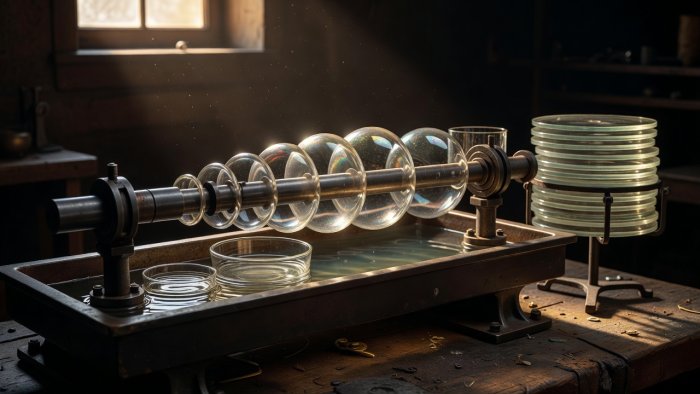
Invention and Mechanical Genesis
During his diplomatic tenure in London in the late 1750s, Benjamin Franklin attended concerts by Edward Delaval playing the "musical glasses"—individual water-filled goblets tuned by varying liquid levels and played by running moistened fingers around the rims. While impressed by the haunting timbre, Franklin observed the setup was mechanically cumbersome, impossible to keep accurately tuned, and restricted to simple monophonic melodies.
Franklin collaborated with a master glassblower in London to engineer custom blown glass bowls of graduated sizes, each featuring an open cylindrical center hole. He mounted 37 bowls horizontally along an iron spindle, nesting them tightly inside one another without touching rims. The spindle was powered by a foot treadle, rotating the glass discs continuously through a shallow trough of distilled water.
Acoustic Purity and Auditory Illusion
The timbre of the glass armonica is unique among acoustic idiophones. Unlike wood or metal strings which produce numerous harmonic partials, a circular quartz or silica glass rim driven by stick-slip friction generates vibrations that closely resemble a pure mathematical sine wave.
Furthermore, the sound operates within the 1,000 to 4,000 Hertz frequency bracket. In human psychoacoustics, this exact spectrum lies at the crossover between time-delay binaural localization and phase-difference localization. As a consequence, human listeners cannot accurately discern the physical origin of the sound in an enclosed room. The music appears to hover directly inside the listener's skull, creating an eerie, disorienting sensation of spiritual intimacy.
"The armonica sounds not like an instrument resting on the floor, but like light turned into sound. It touches nerves that Western harmony rarely touches."— Wolfgang Amadeus Mozart, KV 617 Adagio and Rondo for Glass Armonica (1791)
Mythology, Madness, and Revival
By the early 19th century, urban folklore claimed the armonica induced melancholy, nervous breakdowns, and madness in both listeners and performers. In certain German duchies, public performances were temporarily restricted.
Contemporary medical science points to a simpler historical reality: the finest 18th-century crystal glass contained high concentrations of lead oxide (often up to 30%). Performers spent long hours touching rotating leaded crystal with damp fingertips, resulting in chronic lead poisoning symptoms that contemporaries misattributed to acoustic sorcery.
Today, modern luthiers craft armonica bowls from pure lead-free quartz crystal, bringing compositions by Mozart, Beethoven, and Donizetti back to life with complete physiological safety.
Physical Configuration Matrix
| Component | Material Specification | Operational Function |
|---|---|---|
| Nesting Hemispheres | Graduated Fused Silica Glass | Generates fundamental pitch determined by rim diameter |
| Central Spindle | Turned Stainless Iron Axle | Rotates all 37 bowls uniformly at 60–120 RPM |
| Dampening Trough | Water and mild acetic bath | Maintains uniform friction coefficient against skin pads |
| Actuation Driver | Manual Foot Treadle | Allows dynamic speed control and continuous rotation |
Continue exploring how cultural materials dictate timbre in our analysis of Sub-Saharan Mbira Bridges or review common questions in our Sonic Queries Archive.