Physical Architecture and Wave Mechanics
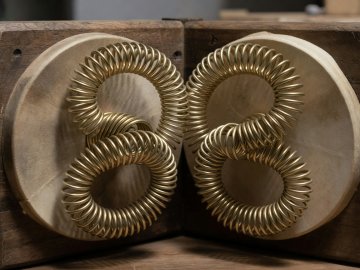
Invented by Turkish musician and sound artist Görkem Şen after more than five years of physical prototyping, the Yaybahar is a monumental freestanding instrument. The foundation consists of two vertical wooden drums—traditionally open-backed frame drums wrapped in synthetic or natural calfskin membranes. Two long, tightly wound coiled steel springs extend outwards from the center of each drum skin, terminating at the wooden bridge of a tall, bowed string column reminiscent of a cello or yaylı tanbur neck.
When the musician bows, plucks, or strikes the vertical strings, mechanical energy does not pass directly into a soundbox. Instead, the vibrational frequency journeys down the long coiled springs. Because steel coils introduce dispersive delay—where high frequencies and low frequencies propagate at markedly different speeds—the signal arrives at the drum membranes as an elongated, undulating sonic wave.
The Resonance of Natural Spring Reverb
In modern recording studios, analog spring reverbs are housed inside compact metal boxes with tiny transducers. The Yaybahar scales this principle to macroscopic proportions. The springs are exposed to the ambient room air, measuring up to two meters in length.
As the vibrating springs activate the large drum heads, the membranes push significant air masses, translating linear mechanical dispersion into spatial acoustic sound pressure. Listeners seated around the instrument report sensations of surround sound and sweeping low-frequency envelopes, frequently comparing the timbre to cinematic science-fiction synthesizers, Tibetan horn blasts, and deep oceanic whale calls.
"The Yaybahar teaches us that acoustic instruments have not exhausted their evolutionary possibilities. By altering the transmission path between bridge and body, physics offers endless uncharted timbres."— Sound Design Quarterly Review (2025)
Performance Techniques and Timbral Modes
Navigating the Yaybahar demands multifaceted dexterity. The performer operates both bows, mallets, and direct palm damping simultaneously:
- Horsehair Bowing: Continuous friction across the upper string frets generates rich harmonic overtones that blossom into sustained drones.
- Spring Mallet Striking: Tapping the coiled springs directly with felt or wooden mallets induces percussive whip-cracks followed by metallic laser-like decay sweeps.
- Membrane Palm Muting: Lightly touching the vibrating skin skins filters high overtones, instantly converting bright clangs into deep sub-bass tremors.
Acoustic Measurement Profile
| Acoustic Metric | Observed Laboratory Range | Comparative Instrument |
|---|---|---|
| Fundamental Pitch | C1 (approx. 32 Hz) to F5 (approx. 698 Hz) | Contrabass / Cello Hybrid |
| Decay Time (RT60) | 4.5 to 8.2 seconds (natural room decay) | Cathedral Pipe Organ / Plate Reverb |
| Dynamic Envelope | Slow acoustic attack, long non-linear release | Modular Analog Synthesizer Pad |
Investigate other physical resonance masters across our atlas, such as the pure rotational friction of the Glass Armonica Discs or consult technical questions in our Sonic Queries Section.