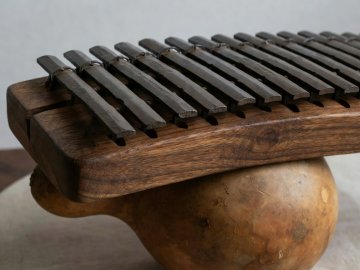
Anatomy of the Plucked Lamellophone
The Mbira dzaVadzimu ("Voice of the Ancestors") consists of 22 to 28 hand-hammered iron or mild steel keys (tines) securely clamped across a bone or copper bridge over a dense hardwood soundboard, traditionally carved from the mubvamaropa (Pterocarpus angolensis) tree. The keys are arranged in three distinct manual registers: a lower-left bass register played with the left thumb, an upper-left tenor register, and a right-hand register plucked upward with the right index finger and downward with the right thumb.
To amplify the acoustic output, the entire wooden assembly is wedged inside a hollowed-out calabash gourd called a deze. A small wooden stick props the instrument tight against the gourd walls, ensuring efficient mechanical energy transfer from the bridge into the resonating spherical cavity.
The Essential Buzz: Acoustic Noise as Sacred Aura
In Western classical ideals, extraneous buzzing or rattling in an instrument is perceived as a structural defect. In Shona ethnomusicology, the rattle is paramount. Bottle caps, snail shells, or metal beads are fastened loosely to the base of the soundboard and along the outer rim of the calabash gourd.
When a metal tine is plucked, the vibration sets the beads into sympathetic kinetic rattling. Acoustically, this introduces broad-spectrum white and pink noise modulation to the plucked note. This intentional distortion masks the physical isolation of single notes, fusing polyrhythmic lines into a continuous, buzzing cloud of sound. In Bira spiritual ceremonies, this acoustic saturation helps facilitate trance states and ancestral communion.
"The mbira is never played by one voice alone. The kushaura (leading part) and kutsinhira (intertwining part) lock together so tightly that a third phantom melody emerges in the listener's ear."— Dr. Stella Chiweshe, Ethnomusicological Archives
Equi-Heptatonic Pitch Systems
Unlike European equal temperament with twelve semitones per octave, traditional mbira tunings frequently employ equi-heptatonic intervals—dividing the octave into seven roughly equal acoustic steps. Notable tunings include:
- Nyamaropa: The canonical classical tuning, featuring balanced Dorian/Mixolydian modal characteristics.
- Gandanga (Mavembe): A darker, contemplative tuning with lowered thirds and sevenths, associated with profound mourning and deep spiritual petitions.
- Dongonda: A dual-tuning layout where the left and right registers overlap in unison intervals to produce rich acoustic chorus oscillations.
Acoustic Construction Specifications
| Component | Material Selection | Acoustic Role |
|---|---|---|
| Plucked Keys (Tines) | Recycled high-carbon wire / Spring steel | Determines fundamental pitch through length and thickness |
| Soundboard (Gwariba) | Hardwood (Mubvamaropa) | Transmits mechanical strain from bridge to calabash resonator |
| Resonator (Deze) | Hard-shelled Calabash Gourd | Boosts lower midrange amplitude and projects acoustic wave |
| Rattlers (Machachara) | Beaten brass discs / Bottle caps | Adds sympathetic non-linear acoustic white noise |
Explore how modal tunings also took root in North American mountain instruments in our guide to Appalachian Dulcimer Modes.